I want to talk about a very common misconception I see, particularly in those working on behaviours that are related to fear/stress/anxiety: 𝐭𝐡𝐞 𝐢𝐝𝐞𝐚 𝐭𝐡𝐚𝐭 𝐚 𝐝𝐨𝐠 𝐭𝐚𝐤𝐢𝐧𝐠 𝐟𝐨𝐨𝐝 𝐢𝐬 𝐚 𝐜𝐥𝐞𝐚𝐫 𝐦𝐚𝐫𝐤𝐞𝐫 𝐨𝐟 𝐟𝐞𝐞𝐥𝐢𝐧𝐠 𝐜𝐨𝐦𝐟𝐨𝐫𝐭𝐚𝐛𝐥𝐞.
It’s an easy mistake to make. We’ve all seen it: a dog is near a trigger, we offer a high-value treat, and they take it. We assume the dog is comfortable because they’re taking food. 𝐈 𝐰𝐚𝐧𝐭 𝐭𝐨 𝐠𝐞𝐧𝐭𝐥𝐲 𝐜𝐡𝐚𝐥𝐥𝐞𝐧𝐠𝐞 𝐭𝐡𝐚𝐭 𝐚𝐬𝐬𝐮𝐦𝐩𝐭𝐢𝐨𝐧.
For dogs that are normally quite foody, if they suddenly won’t take food, it is likely that they are too stressed to do so. They’re telling you they are over their coping threshold. Remember though, that some dogs are just not interested in food in certain situations. Keep an eye on their body language to see if they look stressed or not. They may be more interested in environmental reinforcers, using their senses, and exploring; they may enjoy what the environment can give them, like digging, splashing, watching a squirrel, or just getting on with their walk.
But, coming back to the reason for this post. 𝐒𝐨𝐦𝐞 𝐝𝐨𝐠𝐬 𝐰𝐡𝐨 𝐚𝐫𝐞 𝐡𝐢𝐠𝐡𝐥𝐲 𝐟𝐨𝐨𝐝 𝐦𝐨𝐭𝐢𝐯𝐚𝐭𝐞𝐝 𝐜𝐚𝐧 𝐛𝐞 𝐬𝐭𝐮𝐜𝐤 𝐢𝐧 𝐚 𝐬𝐭𝐚𝐭𝐞 𝐨𝐟 𝐢𝐧𝐭𝐞𝐫𝐧𝐚𝐥 𝐜𝐨𝐧𝐟𝐥𝐢𝐜𝐭 𝐚𝐫𝐨𝐮𝐧𝐝 𝐟𝐨𝐨𝐝. 𝐓𝐡𝐞𝐢𝐫 𝐛𝐫𝐚𝐢𝐧 𝐢𝐬 𝐬𝐚𝐲𝐢𝐧𝐠 “𝐈 𝐧𝐞𝐞𝐝 𝐭𝐨 𝐠𝐞𝐭 𝐚𝐰𝐚𝐲 𝐟𝐫𝐨𝐦 𝐭𝐡𝐢𝐬 𝐬𝐜𝐚𝐫𝐲 𝐭𝐡𝐢𝐧𝐠!” 𝐰𝐡𝐢𝐥𝐞 𝐚𝐧𝐨𝐭𝐡𝐞𝐫 𝐩𝐚𝐫𝐭 𝐢𝐬 𝐬𝐚𝐲𝐢𝐧𝐠 “𝐓𝐡𝐚𝐭 𝐟𝐨𝐨𝐝 𝐢𝐬 𝐚𝐦𝐚𝐳𝐢𝐧𝐠, 𝐈 𝐡𝐚𝐯𝐞 𝐭𝐨 𝐡𝐚𝐯𝐞 𝐢𝐭!”. Judging their internal state purely on if they are taking food is NOT a good marker for them. We HAVE to look at other things too, like their body language, breathing, and so on.
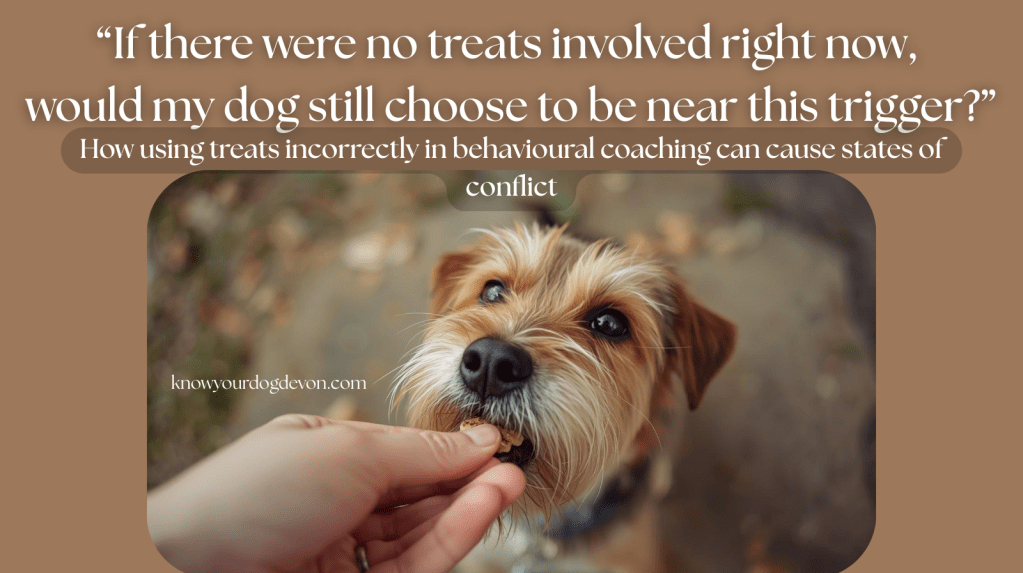
When a dog takes a treat in this state, they’re stuck in a “wobble” between two powerful motivations (the desire to take food, and desire to feel safe). 𝐓𝐡𝐢𝐬 𝐝𝐨𝐞𝐬𝐧’𝐭 𝐡𝐞𝐥𝐩 𝐭𝐡𝐞𝐦 𝐟𝐞𝐞𝐥 𝐛𝐞𝐭𝐭𝐞𝐫; it can actually cause more stress and lead to unpredictable behaviours as they struggle to cope. 𝐓𝐨 𝐤𝐞𝐞𝐩 𝐢𝐭 𝐬𝐢𝐦𝐩𝐥𝐞, 𝐚𝐬𝐤 𝐲𝐨𝐮𝐫𝐬𝐞𝐥𝐟: 𝐢𝐟 𝐭𝐡𝐞𝐫𝐞 𝐰𝐞𝐫𝐞 𝐧𝐨 𝐭𝐫𝐞𝐚𝐭𝐬 𝐢𝐧𝐯𝐨𝐥𝐯𝐞𝐝 𝐫𝐢𝐠𝐡𝐭 𝐧𝐨𝐰, 𝐰𝐨𝐮𝐥𝐝 𝐦𝐲 𝐝𝐨𝐠 𝐬𝐭𝐢𝐥𝐥 𝐜𝐡𝐨𝐨𝐬𝐞 𝐭𝐨 𝐛𝐞 𝐡𝐞𝐫𝐞 (𝐧𝐞𝐚𝐫 𝐭𝐡𝐢𝐬 𝐭𝐫𝐢𝐠𝐠𝐞𝐫)? 𝐈𝐟 𝐭𝐡𝐞 𝐚𝐧𝐬𝐰𝐞𝐫 𝐢𝐬 𝐧𝐨, 𝐭𝐡𝐞𝐧 𝐰𝐞 𝐤𝐧𝐨𝐰 𝐭𝐡𝐞 𝐭𝐫𝐞𝐚𝐭𝐬 𝐚𝐫𝐞 𝐜𝐚𝐮𝐬𝐢𝐧𝐠 𝐜𝐨𝐧𝐟𝐥𝐢𝐜𝐭 𝐫𝐚𝐭𝐡𝐞𝐫 𝐭𝐡𝐚𝐧 𝐚𝐜𝐭𝐮𝐚𝐥𝐥𝐲 𝐡𝐞𝐥𝐩𝐢𝐧𝐠.
𝑻𝒉𝒆 𝑭𝒐𝒖𝒏𝒅𝒂𝒕𝒊𝒐𝒏 𝒐𝒇 𝑩𝒆𝒉𝒂𝒗𝒊𝒐𝒖𝒓
Before we even consider counter-conditioning or desensitisation processes, we must look at the whole picture. 𝐁𝐞𝐡𝐚𝐯𝐢𝐨𝐮𝐫 𝐢𝐬𝐧’𝐭 𝐣𝐮𝐬𝐭 𝐚𝐛𝐨𝐮𝐭 𝐭𝐫𝐚𝐢𝐧𝐢𝐧𝐠; 𝐢𝐭’𝐬 𝐚𝐛𝐨𝐮𝐭 𝐲𝐨𝐮𝐫 𝐝𝐨𝐠’𝐬 𝐜𝐨𝐦𝐩𝐥𝐞𝐭𝐞 𝐰𝐞𝐥𝐥𝐛𝐞𝐢𝐧𝐠. Asking these questions is crucial and MUST be considered before beginning other coaching:
– Physical Health: Could your dog be in pain or discomfort? Are there other medical issues to factor in, or not yet diagnosed? Any underlying medical issue can contribute to your dog’s behavioural output.
– Diet: Is their diet meeting all their nutritional needs? What they eat can directly impact their mood, health, what’s going on in their brain, and energy levels.
– Sleep: Is your dog getting enough quality rest? Like us, a lack of sleep can make dogs less able to cope with stress, and effects their physical health.
– Decompression: Are they getting opportunities to simply be a dog? Walks on a long line in a quiet field or garden can allow them to sniff and decompress without the pressure of triggers. Are we offering decompression activities on walks, and at home?
𝑺𝒐 – 𝒉𝒐𝒘 𝒄𝒂𝒏 𝒘𝒆 𝒉𝒆𝒍𝒑 𝒕𝒐 𝒑𝒓𝒆𝒗𝒆𝒏𝒕 𝒕𝒉𝒊𝒔 𝒔𝒕𝒂𝒕𝒆 𝒐𝒇 𝒄𝒐𝒏𝒇𝒍𝒊𝒄𝒕?
– Prioritise their body language over treats: before you even reach for the treat bag, look at your dog. Are they yawning? Licking their lips? Is their mouth tight? Can you see the whites of their eyes? These are all signs they are feeling uneasy. Are they trying to put space between themselves and the trigger, either by them moving away, or “looking scary” to make the trigger move?
– Manage distance: distance is a dog’s best friend. If your dog is stressed by other dogs, people, or traffic, work at a distance where they are visibly calm and relaxed. If they’re pulling or showing any signs of stress, you are too close. A common example I see with this being done incorrectly, is asking a dog who is worried by strangers, to take a treat out of the strangers hand. If the dog is motivated enough by food, they probably will take it. Then they’re next to the thing they’re scared of. This can easily cause conflict and will not actually help them with their feelings about strangers.
– Control the volume: remember that every trigger adds to the “volume” of a situation. Just because your dog can cope with one person walking past, doesn’t mean they can cope with a whole group. Work on one trigger at a time and slowly build up. Similarly, one calm, senior dog, might be easier for the dog reactive dog to be around, than a collie who is barking whilst waiting for a ball to come out of somebody’s pocket.
Food can be really helpful in training when used right, but it’s only one part of the picture, and this is why so many people find behavioural coaching using reinforcers “does not work” – they haven’t considered all of the factors, they could be asking too much, the environment might be wrong, or the way they’re doing things might not work for that individual dog. 𝐓𝐡𝐞 𝐫𝐞𝐚𝐥 𝐰𝐨𝐫𝐤 𝐜𝐨𝐦𝐞𝐬 𝐟𝐫𝐨𝐦 𝐚𝐬𝐬𝐞𝐬𝐬𝐢𝐧𝐠 𝐭𝐡𝐨𝐬𝐞 𝐟𝐨𝐮𝐧𝐝𝐚𝐭𝐢𝐨𝐧𝐬 𝐟𝐢𝐫𝐬𝐭, 𝐥𝐢𝐬𝐭𝐞𝐧𝐢𝐧𝐠 𝐭𝐨 𝐨𝐮𝐫 𝐝𝐨𝐠𝐬’ 𝐬𝐮𝐛𝐭𝐥𝐞 𝐜𝐮𝐞𝐬, 𝐚𝐧𝐝 𝐜𝐫𝐞𝐚𝐭𝐢𝐧𝐠 𝐚𝐧 𝐞𝐧𝐯𝐢𝐫𝐨𝐧𝐦𝐞𝐧𝐭 𝐰𝐡𝐞𝐫𝐞 𝐭𝐡𝐞𝐲 𝐝𝐨𝐧’𝐭 𝐡𝐚𝐯𝐞 𝐭𝐨 𝐜𝐡𝐨𝐨𝐬𝐞 𝐛𝐞𝐭𝐰𝐞𝐞𝐧 𝐭𝐡𝐞𝐢𝐫 𝐬𝐚𝐟𝐞𝐭𝐲 𝐚𝐧𝐝 𝐚 𝐛𝐢𝐭 𝐨𝐟 𝐬𝐚𝐮𝐬𝐚𝐠𝐞.
If you want to learn more about dog behaviour and increasing their agency within coaching, then get a copy of my book Empowering Your Dog Through Choice on Amazon.
Sally Lewis 2025

 Know Your Dog