An informational post about a breed group that I am seeing much more of recently: Livestock Guardian Dogs. This will be a big post, but an informative one.
Examples of different livestock guardian breeds include the Anatolian Shepherd, the Great Pyrenees, the Kangal, the Caucasian Shepherd, the Komondor, the Romanian Raven Shepherd, the Spanish Mastiff. This is not an exhaustive list of Livestock Guardian breeds but are some that I have seen more commonly in my professional capacity.
Your dog does not have to be a purebred livestock guardian to display behaviours associated with their genetic drive. If they are a cross or mixed breed containing livestock guardian, you may still see this.
What is a livestock guardian dog?
Livestock guardian breed dogs are working breed dogs. They do not herd or move livestock, like herding breeds. Instead, they live amongst livestock as ‘part of the flock/herd’, keeping watch for threats, and protecting them from threats such as predator animals. This is very instinctive genetic behaviour. Livestock guardian dogs are still used across the globe today, especially in more remote farms and ranches.
The livestock guardian dog in a working environment
In the working environment, you can expect this dog breed to keep a watchful eye out for threats. They generally roam without use of things like leads so that they can do their job efficiently. They will be loyal to their flock and their family, but distrusting of things that they aren’t familiar with, or potential threats. They will scan for danger so that they can protect the livestock that they are guarding. They may do perimeter patrolling of fences areas, or bark to warn off threats. They may run at threats. They have been known to get physical in protecting their livestock from predators. Some farms or ranches that use livestock guardian dogs have multiple dogs, to enable one to rest while the other keeps an eye out. The dogs may find a natural ‘shift’ pattern between them, or farm/ranch owners may rotate dogs that are “on shift” if they do not do this naturally. They may alert one another to the presence of threats when they spot, smell, or sense something.
Your livestock guardian within a domestic home environment
Our domestic environments are very busy. Homes and gardens can be surrounded by strange noises, bangs, clatters, barks, traffic sounds. Walks can be equally busy, with lots of strange dogs/people, traffic, cyclists, guests, and various forms of environmental stimulation. Here is some behaviour that I have been contacted about in the past, when working with livestock guardian breeds. When reading this, please reflect on the dog’s instinctive working role and where this behaviour might come from.
Struggling with walking equipment
Pulling on walks
Barking at home in response to external sounds
Territorial barking
Distrust of visitors or tradespeople coming to the home
Distrust of strange people, dogs, or other environmental stimulation on walks
Fence patrolling in the garden, or finding “watch stations” in windows
Loyalty to those that they know well but difficulty accepting new people or animals
Protective behaviour that can sometimes be difficult to manage
Aggression towards people or dogs
….can you see where some of this behaviour might come from? This is why when working with livestock guardian breeds, I will always explore other areas that behaviour could be coming from, and put together coaching/management plans, but I do tend to stress that we aren’t going to turn a livestock guardian that is untrusting of strangers in to a dog that loves them and freely accepts them. It’s like having a working line collie and looking for an ‘off’ button for herding drives.
My livestock guardian breed is such a softy!
Livestock guardians can be very patient with those that are within their social circle, and very loving. They can be very mellow when they are happy, are in the right environment for them, and have their needs met. Livestock guardians can be great companions in the right home, and when their instinctive behaviour that may be displayed is understood.
I am seeing a rise in livestock guardian behavioural enquiries
I live in South Devon, UK. I am seeing a rise in livestock guardian breed cases/enquiries. Many of these dogs that I am seeing, are overseas rescues (overseas rescues are not necessarily always LGDs, but I have seen quite a few recently). This is why it is so important to understand as much as you possibly can about your overseas rescue before adoption or when they arrive with you, and why I often recommend DNA tests when you can. Overseas rescues can be complex dogs with lots of other things to factor in behaviourally and they may not always adapt well to busy home environments. Equally ex-street dogs may have other behavioural tendencies relating to experiences, epigenetics, and trauma that mean they can display some behaviours that sound similar to those above.
Be mindful of other causes for behaviour – there are many
Behaviour can come from many places (there’s not always just one cause). Some of the above behaviours can also be caused by stress, illness, pain, trauma, learning, other emotional drives (fear, anxiety, frustration – some of this can also be genetic), under/over stimulation, lack of appropriate rest, the environment, or diet issues. If you see a sudden change in behaviour from your dog, or a worsening behaviour, you should contact a vet for a health check in the first instance. If you have concerns about your dog’s behaviour, do reach out for help so that all possible causes for behaviour can be assessed.
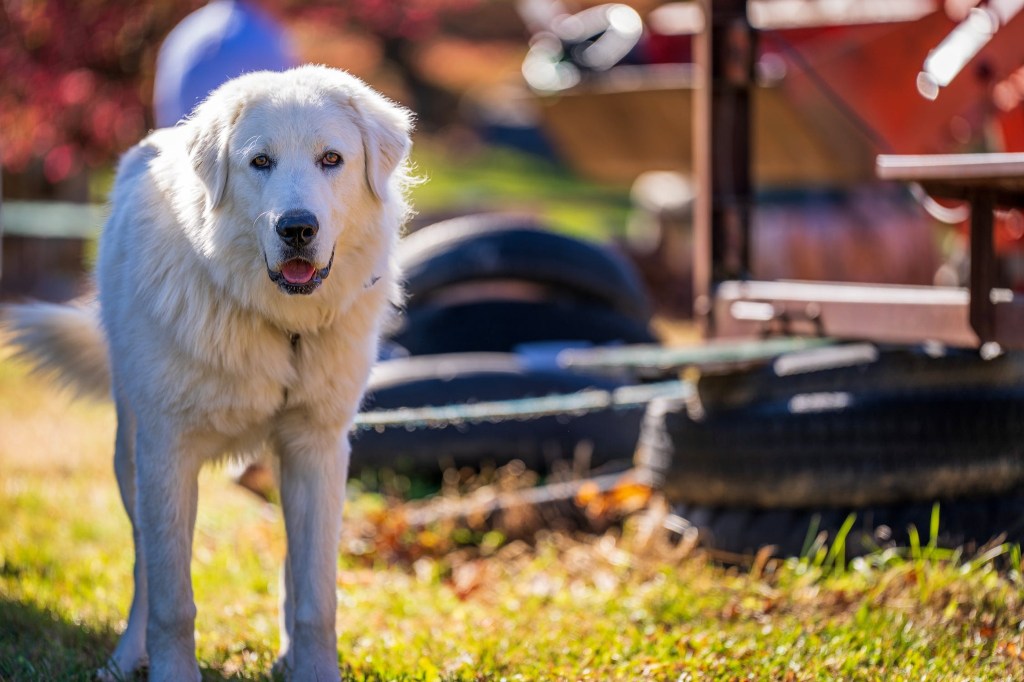
Pictured: Great Pyrenees dog standing on grass. I have seen dogs of this breed be mixed up with Golden Retrievers before – very different dogs!
Sally Lewis 2023

 Know Your Dog