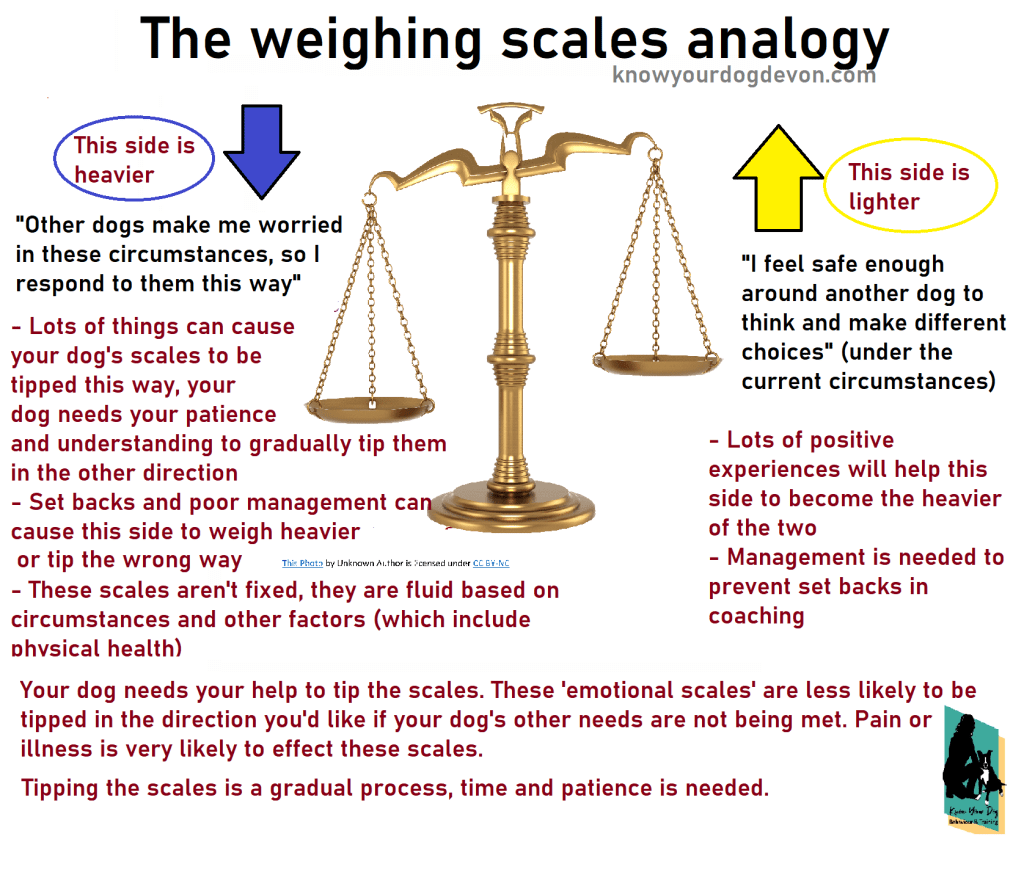
‘The Weighing Scales Analogy’. I’m full of visual analogies! This is one I use with a good chunk of my clients when discussing how we achieve emotional change, so I thought I’d post about it.
I’m going to use a dog that barks and lunges at other dogs due to being anxious around them, as an example.
This dog has a set of weighing scales relating to this issue. One side represents being worried by other dogs and feeling the need to react to them in certain circumstances. The other side represents feeling safe and being able to think about the dog and make new choices, in certain circumstances.
Many things can affect the reason that the scales weigh the way they do – experiences & learning, genetics, physical health (physical health issues should always be treated before behavioural coaching), to name just a few. When coaching dogs to feel differently emotionally, we work to gradually tip the scales. This is not a process that happens quickly due to the way the brain and body work.
The ‘safety’ side is affected by good management (working at the dog’s pace and avoiding stressful exposures), helping the dog to have lots of positive experiences, and helping them to think differently in the situation. This is done at the dog’s individual pace. Imagine placing lots of little pebbles on to that side of the scales, when there is a big rock on the ‘negative’ side. We want to slowly help those scales to tip.
With careful management and effective coaching, the scales will gradually tip. If we have set backs or if management is poor, the scales will tip back the wrong way (just how much depends on the dog’s resilience and ability to recover from events). We must account for this in the case of set backs.
For a dog that is worried by other dogs, this means lots of positive exposure (at a distance your dog is comfortable with), avoidance of being pushed beyond what they might be able to cope with, helping them to build positive associations, think & process, engaging other areas of the brain and calming the nervous system.
Set backs might include management failing (dogs running up to you off lead or popping up where you wouldn’t expect them), trigger stacking, accidentally going beyond the threshold of what your dog can cope with, ill health (to name a few).
Tipping the scales takes patience and understanding. You need to be meeting your dog’s other needs (including health needs) to be successful in tipping the scales. Pain and ill health really effect this process. Once the scales are looking a certain way, they aren’t fixed in place forever, they are fluid so we need to be mindful of our dog’s experience of the world around them.
Sally Lewis 2022

 Know Your Dog